ENGLISH FOR EVERYONE

ENGLISH FOR EVERYONE

Friday, June 15, 2018

Diálogo en Inglés > Llamada Airada a Proveedor


Laura llama a Albert para decirle que un cliente encontró un pelo en una de sus galletas. Albert quiere que Laura olvide el asunto, pero Laura piensa que es algo serio y amenaza en no volver a comprar otra galleta de Albert.


Albert gets an angry call from Laura
Albert recibe una llamada airada de Laura

LauraAlbert, a lady came into the Lucky Market today ranting and raving.
Albert, una mujer vino al Lucky Market esta mañana protestando.
AlbertOh yeah? What happened?
¿Ah sí? ¿Qué pasó?
LauraShe found a blue hair in her chocolate chip cookie!
¡Ella encontró un pelo azul en su galleta de chocolate!
AlbertAha. I can see how she'd be taken aback.
Aha. Puedo imaginar como estaría de sorprendida.
LauraDoes anybody in your family have blue hair?
¿Alguien en tu familia tiene el pelo azul?
AlbertAs a matter of fact, my son's girlfriend Penny has blue hair.
En realidad, la novia de mi hijo Penny tiene el pelo azul.
LauraAlbert, I can't sell your cookies anymore.
Albert, No puedo vender tus galletas más.
AlbertAren't you blowing things out of proportion?
¿No estas exagerando las cosas?
LauraThe health department would throw the book at me if they found out about this.
El departamento de salud me sancionaría si se entera sobre esto.
AlbertCouldn't we just sweep this under the rug?
¿No podríamos solo ocultarlo?
LauraNo. This is too serious.
No. Esto es muy serio.
AlbertBut I was just getting a handle on the cookies business. Now what will I do? I don't have any other way of making a living!
Pero estaba empezando a entender el negocio de las galletas. ¿Y Ahora qué voy a hacer? ¡No tengo otra forma de ganarme la vida!
LauraMy heart goes out to you, Albert, but you need to get your act together. I want to sell chocolate chip cookies, not hair cookies!
Lo siento mucho por ti, Albert, pero necesitas organizarte. Quiero vender galletas de chocolate, ¡no galletas de pelo!
AlbertI guess I just knocked myself out for the past week for nothing.
Supongo que trabajé duro la semana pasada por nada.
LauraClearly!
¡Sin duda!

Expresiones.

Rant and rave. Hablar fuertemente, en un tono de enojo.

Taken aback. Sorprendido (Casi siempre en un sentido negativo).

As a matter of fact. De hecho, en realidad.

Blow things out of proportion. Exagerar.

Throw the book at (someone). Castigar o reprender severamente.

Find out. Descubrir, enterarse.

Sweep (something) under the rug. Ocultar algo, que puede llegar a ser un escandalo.

Get a handle on. Comprender, entender.

Ones heart goes out to (someone). Sentir pena por alguien.

Get one's act together. Organizarse, para comenzar a operar de manera más eficaz.

Know oneself out. Trabajar muy duro en algo.

Thursday, June 14, 2018

Ejercicio Reading IELTS - Herd Mentality


Kaplan ha preparado para nuestro curso IELTS este ejercicio de Reading del IELTS.

Verás que los párrafos del texto aparecen númerados con letra (igual que lo estarán en el examen). En este caso, deberás hacer dos tipos de ejercicios.

El primero es identificar los temas (resumidos en un título) sobre los que se habla en el artículo. Como verás, cabe la posibilidad de que te pongan un tema sobre el que NO se habla en el artículo para nada. Así que ¡cuidado! el ejercicio tiene trampa.

En segundo ejercicio deberás decir si el enunciado es verdadero, falso, o no aparece en el texto.

Recuerda que al leer debes buscar "palabras o expresiones claves" que te den el sentido del texto. 

Las respuestas a los ejercicios las encontrarás más abajo.


-->
READING PASSAGE 1 - HERD MENTALITY 

A. Whenever a large group of people gathers together, there is always a danger that something will go wrong. The worst tragedy which can take place is a crowd surge resulting in a crush. In extreme cases, this can cause death by compressive asphyxia which is where pressure on the chest leaves the person unable to breathe properly.

B. It is often assumed that it is panic which spreads through a crowd which results in an uncontrollable mass only thinking about their own safety. Recent research actually shows people are more likely to act altruistically in times of danger, helping others who are in peril. Their claim is that it is more to do with the management, design and information systems failing than any actions by the participants.

C. With the increasing power of computers, scientists are able to predict how a group will react in a given situation. Crowd Dynamics is a model which is based on three controllable factors which combine mathematics and psychology. The first stage looks at the design of the crowd’s environment, taking into account the way that they will move through a venue as well as any potential bottlenecks. Secondly, the information supplied to the crowd before, during and after the event is evaluated. Finally, how the crowd is managed is studied.

D. A good example of this principle in use is the new Olympic stadium which is being built in East London, England. This enormous arena will be able to hold 80 000 people comfortably in two tiers. Naturally, with this many people together at any one time, it is important to ensure that their movements can be predicted in order to keep them safe.

E. The stadium is built on an island and to facilitate ease of access, five different bridges are being built. These lead the crowds to designated zones which are colour coded. Spectators will be able to see from the colour of their ticket which bridge they need to gain access to their seats. This system automatically means that the crowd can be divided up into much smaller sections of 16 000 and reduce jams.

F. Although at first sight it may seem like a retrograde step, electronic signs are being removed. The thinking behind this is that electrical glitches will not affect the details being given to the spectators. By having more human stewards to help guide the crowds, information can be directed to where it is needed.

G. The final change is to security. There will still be strict checks taking place, but they will be located further away from the venue where the park is wider thus accommodating more people. This will be followed by a more cursory check at the arena itself in the hope that this will keep the flow of spectators moving into the stadium rather than queues developing.

H. Although the programs are not 100% accurate yet, it is hoped that by employing this kind of technology in the development of new venues, it will reduce the risk of serious accidents happening.

******
 ¿Sabes que puedes preparar el IELTS con Kaplan?

 *******
Question 1 

Reading passage 1 has eight paragraphs A – H. Use X if the heading is not used.

Choose the correct heading for each paragraph from the list below. 


I. The problems of overcrowding

II. Controlling crowd numbers

III. The assumption of human nature

IV. Changes to security checks

V. How Crowd Dynamics works

VI. What is studied in Crowd Dynamics

VII. Avoiding queues

VIII. The dangers of large crowds

IX. A modern example of Crowd Dyamics

X. Reducing future risks

XI. A way of reducing crowd numbers

XII. True human nature

XIII. A backward step

XIV. Simplifying technology

**********

Questions 9 – 14 

Are the following statements TRUE, FALSE or NOT GIVEN? 

9. The London Olympic Stadium was designed to be built on an island.

10. Removing electronic signs is a conservative step.

11. Crowd Dynamics is based on manageable facts.

12. People usually help others who are in danger.

13. Security checks will be removed from the London stadium.

14. New venues will use computers when being designed.

*****
Answers:
Question 1
I. X
II. E
III. X
IV.G
V. X
VI. C
VII. X
VIII. A
IX. D
X. H
XI. X
XII. B
XII. X
XIV. F
****
Question 2
9. NOT GIVEN
10. FALSE
11. TRUE
12. TRUE
13. FALSE
14. NOT GIVEN

Wednesday, June 13, 2018

Expresiones en inglés relacionadas con la música


Una buena forma de aprender vocabulario es relacionándolo con imágenes.

Kaplan, ha preparado unas ilustraciones para enseñanos expresiones en inglés relacionadas con la música. Verás que fácil es aprenderlas si memorizas la frase en inglés con su traducción al español y miras el dibujo.

Te recomiendo que pongas las expresiones en IVONA (o software similar) para saber cómo suenan, de lo contrario no te servirán de nada saberlas.

-->

Expresión en inglésSignificadoEjemplo
Elevator musicMúsica agradable pero aburrida que se toca en lugares públicos
-I always listen to elevator musicat the dentist’s
-Siempre escucho música aburrida en el dentista
Ring a bellSonar algo a alguien
-That rings a bell.
-Eso me suena.
For a songComprar, o vender, algo a un precio muy barato
-I bought these shoes for a song.
-Compré estos zapatos por cuatro perras.
Like a broken recordAlguien que repite el mismo discurso una y otra vez
-When she talks about her sister,she sounds like a broken record.

-Cuando ella habla de su hermana parece un disco rayado.
Blow your own trumpetFardar de tus propios éxitos o talentos
-Peter often blows his own trumpet.
-Frecuentemente, Peter farda de sus éxitos.
Jam sessionTocar música de manera improvisada en un entorno informal
-My friends had a jam sesión last weekend and the neighbours complained.

-Mis amigos se pusieron a tocar música de manera improvisada el fin de semana pasada y los vecinos. protestaron.

Aquí tienes la imagen preparada por Kaplan:


Lee aquí el post original de Kaplan.

Tuesday, June 12, 2018

Parts of Speech – Word Classes


What is an adverb? What is a preposition? What is a…?
These are questions that students sometimes ask when a teacher is explaining a grammar point.
The different parts of speech (or all of those “grammar words” as some students call them) are important to know when learning English, or any other language.
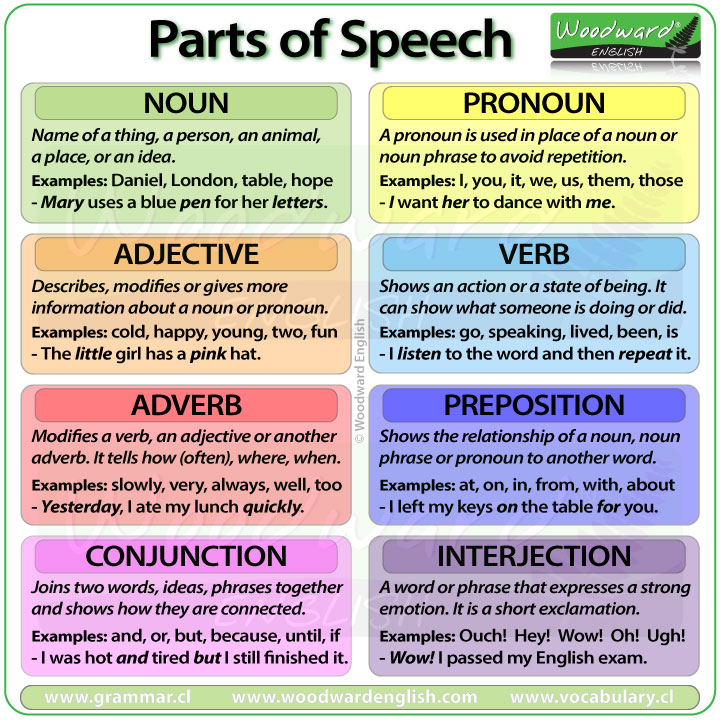
In order to help solve doubts about what the different parts of speech are and what functions they have, I created a summary chart and a video explaining the main differences between each one.

Parts of Speech in English – ESL Video

In our ESL video, we look at the eight parts of speech in traditional English grammar.
These parts of speech, sometimes called word classes, include:
Nouns, Pronouns, Adjectives, Verbs, Adverbs, Prepositions, Conjunctions, and Interjections.
We give an explanation of how each word class is used and have included example sentences. For some of the parts of speech we also look at sub-classes such as subject pronouns and possessive pronouns, the different types of adverbs such as adverbs of manner, adverbs of frequency, etc.
In the final section we talk about how some teachers sometimes include a 9th part of speech which can be either Articles or Determiners. Again, we include examples.
This ESL video to ideal to give students a general overview of the different parts of speech in English.

Summary Chart


Parts of Speech in English - Nouns, Pronouns, Adjectives, Verbs, Adverbs, Prepositions, Conjunctions, and Interjections.

English Teacher Resource

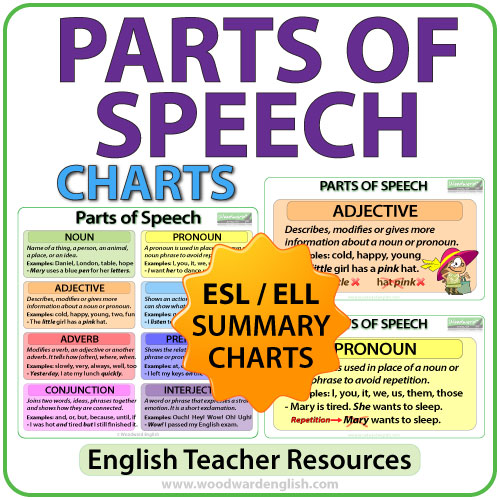
We have created the following summary charts that can be used in the classroom or for homeschooling:

English Parts of Speech Charts - Word Classes

Monday, June 11, 2018

Say y tell estilo directo y estilo indirecto.


Say and tell in direct speech and reported speech. - Say y tell en el estilo directo y el estilo indirecto.


Present
Past
Participle
say / says
said
said
tell / tells
told
told

Podemos traducir say y tell en español como "decir". Sin embargo, en inglés usamos estos verbos en distintas maneras. Existen unas reglas que indican el uso de uno sobre el otro en inglés, aunque en general usamos say para "decir algo" y tell para "decir algo a alguien."
Por ejemplo;
  • “I’m tired,” she said. - “Estoy cansada,” dijo.
  • She told me, “I’m tired” - Me dijo, “Estoy cansada”

Say

Usamos say en el estilo directo y el indirecto. Si usamos say con un objeto personal, necesitamos usar to.
Direct speech - Estilo directo
  • "I'm hungry," he said. - "Tengo hambre,"  dijo.
  • "I need your help," Peter said to Mary. - "Necesito tu ayuda," Peter dijo a Mary.
  • She said, "Do you like to dance?" - Ella dijo, "¿Te gusta bailar?"

Reported speech - Estilo indirecto
  • He said he was hungry. - Él dijo que tenía hambre.
  • Glen said to Mike that he needed his help. - Peter dijo a Mary que necesitaba su ayuda.
  • She asked me if I liked to dance. - Me preguntó si me gustaba bailar.

Tell

También podemos usar tell con el estilo directo o el indirecto, aunque el uso con el estilo directo no es tan común. Cuando usamos tell necesitamos usar un objeto indirecto que va detrás del verbo.

Direct speech - Estilo directo
  • He told me, "I'm hungry." - Me dijo, "Tengo hambre."
  • Peter told Mary, "I need your help." - Peter dijo a Mary, "Necesito tu ayuda."

Reported speech - Estilo indirecto
  • He told me that he was hungry. - Me dijo que tenía hambre.
  • Peter told Mary that he needed his help. - Peter dijo a Mary que necesitaba su ayuda.

Otros usos de tell:
Usamos tell cuando damos órdenes o instrucciones.
  • He told me to shut up. - Me dijo que me callara.
  • She told us to hurry. - Nos dijo que nos diéramos prisa.
  • They told us to come in. - Nos dijeron que entráramos.

Usamos tell para dar o pedir información.
  • Can you tell me your name please. - Díme tu nombre, por favor.
  • You told him the address of the office? - ¿Le dijiste la dirección de la oficina?

Usamos tell con cuentos o bromas. En estos casos, podemos traducir tell como "contar" en español.
  • He told us a funny story. - Nos contó un cuento divertido.
  • "Tell me a joke," she said. - "Cuéntame un chiste," dijo ella.

También usamos tell con;
  • "Tell me the truth," she said. - "Dime la verdad," dijo ella..
  • "Could you tell me the time, please?" she asked. - "Podrías decirme la hora, por favor?" me preguntó.

Friday, June 8, 2018

LinguaPracticaVR - Learn English in Virtual Reality


vr%2Bwaterfall%2B2.PNG
As I walked around the BETT Show last week there seemed to be a vendor selling a virtual reality product at every turn. LinguaPracticaVR is one of those VR products that I tested. 

LinguaPracticaVR offers free English lessons in a virtual reality context. LinguaPracticaVR builds short lessons into virtual reality images of places in Ireland and the United Kingdom. For example, in the screenshot below you will see an image of the Powerscourt Waterfall. Within that image there are three short lessons about the words used to describe what is seen in the image. 

Applications for Education 
LinguaPracticaVR is a still in the early phases of its development, but there is excellent potential for its use as an instructional tool. One thing to note is that it seems to be built with high school age or older ELL/ ESL learners. I say that because one of the tours includes a visit to a pub.

Thursday, June 7, 2018

Lingualia, cursos de idiomas que se adaptan a ti


Lingualia no es sólo una red social para aprender idiomas en la que conocer gente y practicar con nativos, sino que además es una nueva y revolucionaria forma de hacerlo.

Pero... ¿qué significa que en Lingualia todo se adapta a cada usuario?

Generalmente todos los cursos online, ya sean de idiomas o de otras materias, siguen una estructura lineal, donde el usuario tiene que ir pasando unidades y lecciones que requieren siempre de un tiempo fijo y predeterminado. Y donde el curso es exactamente igual para todos los estudiantes independientemente de sus necesidades, edad, formación previa o intereses.

Sin embargo, en Lingualia se apuesta por por un sistema adaptativo, donde el usuario no es el que se tiene que adaptar al curso, sino que el curso automáticamente se adapta a las necesidades de cada usuario.

Lingu1

¿Cómo lo consiguen? De formas muy diversas:

Analizando tu progreso:
Hay estudiantes que tienen más facilidad en el vocabulario que en ciertos aspectos de la gramática como los verbos. A otros estudiantes les cuesta más la expresión escrita o la comprensión.
El curso se centra en lo que realmente necesita cada estudiante de forma automática.

Adaptándose a tu objetivo:
No es lo mismo un estudiante que quiere aprender inglés para mejorar su carrera profesional, encontrar un mejor empleo o completar su CV, que un usuario que quiere aprender idiomas para viajar, conocer nuevos amigos, o porque le gusta la cultura en general.

Motivación:
Mantener la motivación del estudiante es uno de los retos más importantes de los cursos online. Una de las formas de conseguir esto es personalizando los contenidos según tus intereses, aumentando así tu motivación.

Considerando tu tiempo disponible:
No importa si dispones de 5 o de 45 minutos, Lingualia se adapta a cada horario y es completamente flexible. Al no ser un curso lineal, no exige un tiempo mínimo para finalizar cada lección y es capaz de concentrar sesiones de aprendizaje y adaptarse a cada usuario.

¿Qué te ofrece Lingualia?
Lingu es el profesor inteligente hecho a tu medida que utiliza inteligencia artificial para adaptarse a ti.
Con él progresarás más rápido porque se centra exclusivamente en tus necesidades. Te hará preguntas de forma progresiva, te guiará en aquello que necesitas reforzar y también te ayudará a repasar lo que ya has aprendido.

Lingu2

Juegos: reta a tus amigos a un duelo de idiomas a la vez que aprendes gramática, vocabulario o fonética de forma natural y divertida. Sólo tienes que responder correctamente y en el menor tiempo posible todas las preguntas del desafío.

Lecciones: material didáctico creado por profesionales de la educación y basado en el Marco Común Europeo de Referencia para las Lenguas (MCER) que trabaja todas las áreas lingüísticas a través de cuatro tipos de tarjetas educativas, también llamadas flashcards:
- Diálogos: mejora tu comprensión a través de diálogos reales donde se muestra el uso contextualizado del vocabulario y de las expresiones así como el de diversas estructuras gramaticales.
- Fonética: te enseñan la pronunciación más correcta y te ayudan a que mejores la tuya.
- Gramática: explicaciones fáciles de leer, claras y directas. Aprender gramática no tiene por qué ser duro.
- Vocabulario: aprende miles de palabras importantes con la ayuda de imágenes, su pronunciación y la definición.

Actividades: ejercicios que se inspiran en los gustos, en las preferencias y progreso de cada estudiante y que se comparten con los otros miembros de la comunidad de Lingualia.
Los usuarios pueden comentar, hacer correcciones y sugerencias, y también aportar su punto de vista o sus conocimientos a los ejercicios realizados por otros estudiantes.

Lingu3

¿Quieres probar las nuevas lecciones?

Regístrate ahora en Lingualia

Lingualia incluye más de 200 lecciones, divididas en 4 niveles (A1, A2, B1 y B2), compuestas por un diálogo, vocabulario, frases de ejemplo, fichas de gramática, fonética y una revisión final, donde Lingu - nuestro profesor inteligente – examinará tu progreso de forma detallada.

Wednesday, June 6, 2018

Cómo aprenderse las vocales en inglés para deletrear sin problemas


Pregunta:

Me cuestan las vocales A, E, I. Aunque sé cómo se pronuncian cada una y voy practicando con listenings todos los días, a la hora de que me deletreen una palabra me suelo liar bastante.

¿Hay algún truco más que me puedas recomendar?

María

*******
Respuestas:

El problema de María es muy común.

Y es fácil ver porqué se lía con las vocales tres primeras vocales en inglés.

Si se las compara con las tres primeras vocales en español, vermos que los sonidos están intercambiados y la mente se vuelve loca intentando dar con la combinación de letra y sonido correcta.

Estos son los sonidos.:

  • A =EI
  • E = I
  • I = AI

Como ves, al pronunciar estas letras tenemos la impresión de que:

  • La A es la E
  • La E es la I
  • La I es la

No tengo ningún truco para resolver este problema, así que lo que te aconsejo hacer es repetir CIENTOS de veces los sonidos hasta que se te queden grabados.

Esto es lo que haremos:


1. Decir en voz alta 100 veces cada uno de estos sonidos.


A =EI

E = I

I = AI

2. Escuchar esta pegadiza canción unas 20 veces (hasta que te salga por los oídos y no la soportes).  Sí, es para niños pero no hay remedio, hay que aprender los sonidos como sea.


3.  Luego haremos unos ejercicios de spellings.

Ejercicio 1. Todo el alfabeto
Ejercicio 2. Spelling de calles
Ejercicio 3 Lugares comunes de Inglaterra
Ejercicio 4. Nombres de gente conocida

Si aún no has aprendido los 3 primeros sonidos, vuelve a repetir toda la serie de ejercicicios. Repítelos hasta que puedas decir las vocales comodamente. Cuando no te confundas, podrás decir que ya te sabes las vocales.

Tuesday, June 5, 2018

Conversación Familiar sobre el Maravilloso día de Escuela


En esta conversación intervienen 3 miembros de una familia, la madre, la hija y el hijo. Donde el tema principal es el maravilloso día de escuela de la hija.

Lucy le cuenta a su madre Mary sobre su excelente día en la escuela. Su hermano Harry las escucha e interrumpe la conversación.

A wonderful day at school
Un maravilloso día en la escuela


MaryHow was your day at school, Lucy?
¿Cómo de fue hoy en la escuela Lucy?
LucyIt was great, Mom. I gave a presentation on Hillary Clinton in government class. Afterwards, my teacher paid me a compliment.
Fue genial mamá. Tuve una presentación sobre Hillary Clinton en la clase de gobierno. Después mi maestra me felicitó por mi presentación.
MaryWhat did she say?
¿Qué te dijo?
LucyShe said my presentation was head and shoulders above the others.
Ella dijo que mi presentación estaba muy por encima de los demás.
MaryWay to go!
¡Así se hace!
LucyShe also said I should go into politics, just like Hillary.
Ella también dijo que debería entrar a la política tal como lo hizo Hillary.
HarryYou're so gung ho about school. It drives me crazy.
Estás tan emocionada por la escuela. Que eso me vuelve loco.
MaryHarry, don't butt in! You're just jealous.
Harry, ¡no te metas! solo estás celoso.
HarryRight. You hit the nail on the head. I'm green with envy. 
Es cierto, acertaste. Estoy verde de envidia.
MaryWould you just shut up? You're on thin ice with me right now.
¿Podrías callarte? Estas en la cuerda floja conmigo ahora mismo.
HarryOh no! Look at me. I'm shaking in my shoes!
¡Oh no!  mírame, ¡estoy temblando de miedo!

Expresiones:

Pay (someone) a compliment. Dar un cumplido, ofrecer a alguien una admiración.

Head and shoulders above. Para indicar que algo está muy superior a otro.

Way to go! Exclama que algo se hizo muy bien.

Go into. Entrar a alguna profesión.

Gung ho. Indica gran entusiasmo sobre algo.

Drives (one) crazy. Para indicar que algo molesta demasiado.

Butt in! Indica interrumpir o interferir.

Hit the nail on the head. Expresión coloquial que indica que algo es correcto.

On thin ice with (someone). Indica que se está en una peligrosa situación.

Shak in one's shoes. Temblar de miedo, estar asustado.

Monday, June 4, 2018

Plural Words, A Silent "B," and the History of English


English is a tricky language. Silent letters and quirky rules about plural and possessive words will trip up native speakers as well as ESL students. TED-Ed and The Open University offer short lessons on the evolution of English and some of its trickier rules.

A Brief History of Plural Words - complete lesson.


Why is there a "b" in doubt? - complete lesson.


The History of English in Ten Minutes.

Friday, June 1, 2018

6 recursos para aprender inglés a través de la red

Todo lo que puedes hacer para aprender inglés
Aprender y dominar el inglés parece la asignatura eternamente pendiente entre la mayoría de los habitantes de los países de habla hispana. Así lo demuestran las estadísticas y los análisis, año tras año.
Aprender inglés facilmente
Existen muchas maneras de aprender y mejorar el inglés, casi tantas como excusas para no hacerlo. Hoy te invitamos a descubrir todo lo que tienes a tu alcance para aprender y mejorar tu nivel de inglés y así aprobar definitivamente esta asignatura pendiente. Toma nota, encontrarás el que se adapta a tus necesidades. ¡Tienes muchas posibilidades a tu alcance!
Recursos educativos para aprender inglés
  1. Duolingo: Web que te permite saber el nivel que tienes y empezar rápidamente a practicar con diferentes actividades. Los creadores de la web calculan que con 100 horas puedes obtener un nivel intermedio de inglés.
  2. Palabea: Vídeo chat a través del que puedes hablar y escuchar para aprender inglés con diferentes habitantes de países de habla hispana.
  3. Busuu: Red social que te permite acceder a ejercicios interactivos y actividades para aprender inglés. Además podrás contactar y compartir conocimientos y dudas con otros usuarios.
  4. Livemocha: Web en inglés que propone la creación de un mundo sin barreras, paraaprender, enseñar y explorar. Es una efectiva herramienta para que alumnos y trabajadores aprendan inglés.
  5. Babbel: Sistema de aprendizaje que combina las ventajas de métodos pedagógicos tradicionales con las nuevas tecnologías. Una sencilla manera para aprender idiomas on-line.
  6. Vocabsushi: Web que te permite construir tu vocabulario. Es ideal para los estudiantes que están preparando los exámenes y también para todas aquellas personas que deseen mejorar la precisión a la hora de comunicarse.
¿Has probado alguno de estos recursos? ¿Conoces otras maneras para aprender inglés a través de la red? ¡Tienes vía libre para compartir tu experiencia con nosotros!