ENGLISH FOR EVERYONE

ENGLISH FOR EVERYONE

Tuesday, June 19, 2018

Diálogo en inglés > Madre Orgullosa de sus 2 Hijos

En este diálogo en inglés presentamos a una madre que recibe buenas noticias por parte de sus hijos, lo que la hace sentir muy orgullosa de ellos. Harry le cuenta a su madre que un agente de talentos quiere entrevistarlo. El agente llevará a Harry a Nueva York. Su hermana Lucy también tiene buenas noticias, ella ha sido nombrada como la presidenta del Club de Italiano.

Harry brings home more good news
Harry trae a casa más nuevas noticias

HarryPenny and I are going to break into the music business. Last night after our concert, a talent agent asked us to meet with him in New York.
Penny y yo vamos a entrar al negocio de la música. Ayer por la noche después de nuestro concierto, un agente de talento nos pidió reunirnos con él en Nueva York
MaryCongratulations! We'll give you some spending money for your trip.
¡Felicidades! Vamos a darte algo de dinero para tu viaje.
HarryNo need. The agent is footing the bill for everything. And when we get there, he's going towine and dine us.
No es necesario. El agente está pagando todos los gastos. Y cuando lleguemos allí, él va a invitarnos a festejar.
MaryHe must think you're the cream of the crop.
Él debe creer que ustedes son los mejores.
HarryHe thinks we sound like the Green Day.
Él piensa que nos parecemos a Green Day
LucyWho are they?
¿Quienes son?
HarryYou're really out of it. They're a popular rock band.
Realmente no estás actualizada. Son una banda de rock.
LucyOur family is certainly on a winning streak. I was elected president of the Italian Club today.
Nuestra familia en verdad está en una racha ganadora. Hoy fui elegida como presidenta del Club Italiano.
HarryThe Italian Club? Big deal!
¿El Club Italiano? ¡Gran cosa!
LucyYou don't get it, Harry. This is only the beginning. Today, president of the Italian Club. Tomorrow, ambassador to Italy.
No lo entiendes, Harry. Es solo el principio. Hoy presidente del Club Italiano. Mañana, embajadora de Italia.
HarryWell, Ambassador, you'll need to wrap up my chemistry homework before you leave for the Italy Embassy.
Bien, embajadora, tendrás que terminar mi tarea de química antes que vayas a la embajada de Italia.
MaryA rock star and a diplomat. I'm so proud of both of you!
Una estrella de rock y una diplomática. ¡Estoy muy orgullosa de ambos!

Expresiones.

Break into. Entrar en una profesión.

Spending money. Dinero para pequeños gastos.

Foot the bill. Pagar.

Wine and dine. Invitar a alguien una noche o comida cara.

Cream of the crop. El mejor de un grupo.

Out of it. No consientes de las últimas tendencias, hábitos, modas modernas.

Winning streak. Una serie de triunfos, una racha ganadora.

Big deal. ¿Y qué? eso no es realmente importante.

Wrap up. Terminar.

Monday, June 18, 2018

Conversación en Inglés > 2 Mujeres Hablando de Negocios por Teléfono


Conversación de teléfono entre 2 mujeres, donde una pretende comprar el negocio de la otra. Carol de National Cookie Company llama a Mary. Ella quiere comprar sus galletas. Mary está muy contenta pero espera que su esposo cierre el trato.

Mary gets a surprise call.
Mary tiene una inesperada llamada.


MaryHello?
¿Hola?
CarolGood afternoon. Are you Mary, of Mary's Scrumptious Cookies?
Buenas tardes. ¿Es Mary, de 
Deliciosas Galletas Mary?
MaryYes I am.
Si lo soy.
CarolMy name is Carol Miller, and I'm calling from the National Cookie Company. We're nuts about your cookies, and we'd like to sell them all over the country.
Mi nombre es Carol Miller y la llamo de parte de National Cookie Company. Estamos encantados con sus galletas, y nos gustaría venderlos en todo el país.
MaryUnfortunately, we're running on a shoestring out of our kitchen. We can't make enough cookies for you.
Desafortunadamente, Operamos con un bajo presupuesto en nuestra cocina. No podemos hacer suficientes galletas para ustedes.
CarolMy company wants to buy the recipe and the brand name from you.
My compañía quiere comprar su receta y la marca.
MaryOh yeah? Why would you want to do that?
¿Ah, sí? ¿Por qué quisieran hacer eso?
CarolWe have a successful track record of buying small companies and turning them into big ones.
Tenemos una exitosa trayectoria comprando pequeñas empresas y convertirlas grandes empresas.
MaryIn that case, I'm sure we can come to an agreement.
En ese caso, estoy segura que podemos llegar a un acuerdo.
CarolGreat. You just made my day!
Excelente. ¡Me gusta escuchar eso!
MaryYou'll need to work out the nuts and bolts of the agreement with my husband. He's the business manager.
Necesitas hablar de los detalles del acuerdo con mi esposo. Él es el encargado del negocio.
CarolMay I speak with him now?
¿Puedo hablar con él ahora?
MaryHe's at a meeting. I'll have him get in touch with you when he returns.
Está en una reunion. Haré que se ponga en contacto con usted cuando regrese.
CarolGood. I look forward to speaking with him.
Bien. Espero con ansias hablar con él.

Expresiones.

All over. A lo largo de, en todas partes.

On a shoestring. Presupuesto muy bajo.

Track record. Trayectoria.

Make one's day. Dar una gran satisfacción a alguien.

Work out. Encontrar una solución, resolver algo.

Nuts and bolts. Detalles, componentes básicos de algo.

In touch with. Poner en contacto con alguien.

Look forward to. Esperar ansiosamente.

Friday, June 15, 2018

Diálogo en Inglés > Llamada Airada a Proveedor


Laura llama a Albert para decirle que un cliente encontró un pelo en una de sus galletas. Albert quiere que Laura olvide el asunto, pero Laura piensa que es algo serio y amenaza en no volver a comprar otra galleta de Albert.


Albert gets an angry call from Laura
Albert recibe una llamada airada de Laura

LauraAlbert, a lady came into the Lucky Market today ranting and raving.
Albert, una mujer vino al Lucky Market esta mañana protestando.
AlbertOh yeah? What happened?
¿Ah sí? ¿Qué pasó?
LauraShe found a blue hair in her chocolate chip cookie!
¡Ella encontró un pelo azul en su galleta de chocolate!
AlbertAha. I can see how she'd be taken aback.
Aha. Puedo imaginar como estaría de sorprendida.
LauraDoes anybody in your family have blue hair?
¿Alguien en tu familia tiene el pelo azul?
AlbertAs a matter of fact, my son's girlfriend Penny has blue hair.
En realidad, la novia de mi hijo Penny tiene el pelo azul.
LauraAlbert, I can't sell your cookies anymore.
Albert, No puedo vender tus galletas más.
AlbertAren't you blowing things out of proportion?
¿No estas exagerando las cosas?
LauraThe health department would throw the book at me if they found out about this.
El departamento de salud me sancionaría si se entera sobre esto.
AlbertCouldn't we just sweep this under the rug?
¿No podríamos solo ocultarlo?
LauraNo. This is too serious.
No. Esto es muy serio.
AlbertBut I was just getting a handle on the cookies business. Now what will I do? I don't have any other way of making a living!
Pero estaba empezando a entender el negocio de las galletas. ¿Y Ahora qué voy a hacer? ¡No tengo otra forma de ganarme la vida!
LauraMy heart goes out to you, Albert, but you need to get your act together. I want to sell chocolate chip cookies, not hair cookies!
Lo siento mucho por ti, Albert, pero necesitas organizarte. Quiero vender galletas de chocolate, ¡no galletas de pelo!
AlbertI guess I just knocked myself out for the past week for nothing.
Supongo que trabajé duro la semana pasada por nada.
LauraClearly!
¡Sin duda!

Expresiones.

Rant and rave. Hablar fuertemente, en un tono de enojo.

Taken aback. Sorprendido (Casi siempre en un sentido negativo).

As a matter of fact. De hecho, en realidad.

Blow things out of proportion. Exagerar.

Throw the book at (someone). Castigar o reprender severamente.

Find out. Descubrir, enterarse.

Sweep (something) under the rug. Ocultar algo, que puede llegar a ser un escandalo.

Get a handle on. Comprender, entender.

Ones heart goes out to (someone). Sentir pena por alguien.

Get one's act together. Organizarse, para comenzar a operar de manera más eficaz.

Know oneself out. Trabajar muy duro en algo.

Thursday, June 14, 2018

Ejercicio Reading IELTS - Herd Mentality


Kaplan ha preparado para nuestro curso IELTS este ejercicio de Reading del IELTS.

Verás que los párrafos del texto aparecen númerados con letra (igual que lo estarán en el examen). En este caso, deberás hacer dos tipos de ejercicios.

El primero es identificar los temas (resumidos en un título) sobre los que se habla en el artículo. Como verás, cabe la posibilidad de que te pongan un tema sobre el que NO se habla en el artículo para nada. Así que ¡cuidado! el ejercicio tiene trampa.

En segundo ejercicio deberás decir si el enunciado es verdadero, falso, o no aparece en el texto.

Recuerda que al leer debes buscar "palabras o expresiones claves" que te den el sentido del texto. 

Las respuestas a los ejercicios las encontrarás más abajo.


-->
READING PASSAGE 1 - HERD MENTALITY 

A. Whenever a large group of people gathers together, there is always a danger that something will go wrong. The worst tragedy which can take place is a crowd surge resulting in a crush. In extreme cases, this can cause death by compressive asphyxia which is where pressure on the chest leaves the person unable to breathe properly.

B. It is often assumed that it is panic which spreads through a crowd which results in an uncontrollable mass only thinking about their own safety. Recent research actually shows people are more likely to act altruistically in times of danger, helping others who are in peril. Their claim is that it is more to do with the management, design and information systems failing than any actions by the participants.

C. With the increasing power of computers, scientists are able to predict how a group will react in a given situation. Crowd Dynamics is a model which is based on three controllable factors which combine mathematics and psychology. The first stage looks at the design of the crowd’s environment, taking into account the way that they will move through a venue as well as any potential bottlenecks. Secondly, the information supplied to the crowd before, during and after the event is evaluated. Finally, how the crowd is managed is studied.

D. A good example of this principle in use is the new Olympic stadium which is being built in East London, England. This enormous arena will be able to hold 80 000 people comfortably in two tiers. Naturally, with this many people together at any one time, it is important to ensure that their movements can be predicted in order to keep them safe.

E. The stadium is built on an island and to facilitate ease of access, five different bridges are being built. These lead the crowds to designated zones which are colour coded. Spectators will be able to see from the colour of their ticket which bridge they need to gain access to their seats. This system automatically means that the crowd can be divided up into much smaller sections of 16 000 and reduce jams.

F. Although at first sight it may seem like a retrograde step, electronic signs are being removed. The thinking behind this is that electrical glitches will not affect the details being given to the spectators. By having more human stewards to help guide the crowds, information can be directed to where it is needed.

G. The final change is to security. There will still be strict checks taking place, but they will be located further away from the venue where the park is wider thus accommodating more people. This will be followed by a more cursory check at the arena itself in the hope that this will keep the flow of spectators moving into the stadium rather than queues developing.

H. Although the programs are not 100% accurate yet, it is hoped that by employing this kind of technology in the development of new venues, it will reduce the risk of serious accidents happening.

******
 ¿Sabes que puedes preparar el IELTS con Kaplan?

 *******
Question 1 

Reading passage 1 has eight paragraphs A – H. Use X if the heading is not used.

Choose the correct heading for each paragraph from the list below. 


I. The problems of overcrowding

II. Controlling crowd numbers

III. The assumption of human nature

IV. Changes to security checks

V. How Crowd Dynamics works

VI. What is studied in Crowd Dynamics

VII. Avoiding queues

VIII. The dangers of large crowds

IX. A modern example of Crowd Dyamics

X. Reducing future risks

XI. A way of reducing crowd numbers

XII. True human nature

XIII. A backward step

XIV. Simplifying technology

**********

Questions 9 – 14 

Are the following statements TRUE, FALSE or NOT GIVEN? 

9. The London Olympic Stadium was designed to be built on an island.

10. Removing electronic signs is a conservative step.

11. Crowd Dynamics is based on manageable facts.

12. People usually help others who are in danger.

13. Security checks will be removed from the London stadium.

14. New venues will use computers when being designed.

*****
Answers:
Question 1
I. X
II. E
III. X
IV.G
V. X
VI. C
VII. X
VIII. A
IX. D
X. H
XI. X
XII. B
XII. X
XIV. F
****
Question 2
9. NOT GIVEN
10. FALSE
11. TRUE
12. TRUE
13. FALSE
14. NOT GIVEN

Wednesday, June 13, 2018

Expresiones en inglés relacionadas con la música


Una buena forma de aprender vocabulario es relacionándolo con imágenes.

Kaplan, ha preparado unas ilustraciones para enseñanos expresiones en inglés relacionadas con la música. Verás que fácil es aprenderlas si memorizas la frase en inglés con su traducción al español y miras el dibujo.

Te recomiendo que pongas las expresiones en IVONA (o software similar) para saber cómo suenan, de lo contrario no te servirán de nada saberlas.

-->

Expresión en inglésSignificadoEjemplo
Elevator musicMúsica agradable pero aburrida que se toca en lugares públicos
-I always listen to elevator musicat the dentist’s
-Siempre escucho música aburrida en el dentista
Ring a bellSonar algo a alguien
-That rings a bell.
-Eso me suena.
For a songComprar, o vender, algo a un precio muy barato
-I bought these shoes for a song.
-Compré estos zapatos por cuatro perras.
Like a broken recordAlguien que repite el mismo discurso una y otra vez
-When she talks about her sister,she sounds like a broken record.

-Cuando ella habla de su hermana parece un disco rayado.
Blow your own trumpetFardar de tus propios éxitos o talentos
-Peter often blows his own trumpet.
-Frecuentemente, Peter farda de sus éxitos.
Jam sessionTocar música de manera improvisada en un entorno informal
-My friends had a jam sesión last weekend and the neighbours complained.

-Mis amigos se pusieron a tocar música de manera improvisada el fin de semana pasada y los vecinos. protestaron.

Aquí tienes la imagen preparada por Kaplan:


Lee aquí el post original de Kaplan.

Tuesday, June 12, 2018

Parts of Speech – Word Classes


What is an adverb? What is a preposition? What is a…?
These are questions that students sometimes ask when a teacher is explaining a grammar point.
The different parts of speech (or all of those “grammar words” as some students call them) are important to know when learning English, or any other language.
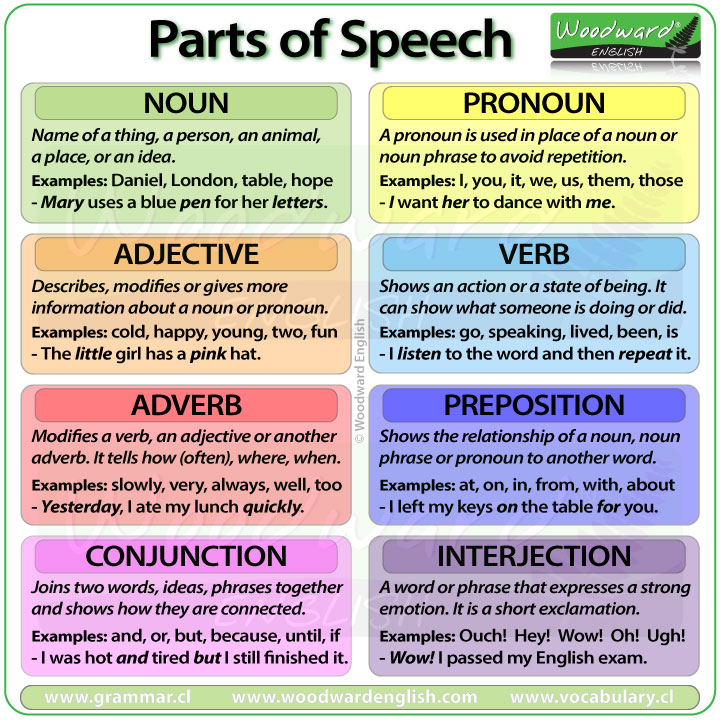
In order to help solve doubts about what the different parts of speech are and what functions they have, I created a summary chart and a video explaining the main differences between each one.

Parts of Speech in English – ESL Video

In our ESL video, we look at the eight parts of speech in traditional English grammar.
These parts of speech, sometimes called word classes, include:
Nouns, Pronouns, Adjectives, Verbs, Adverbs, Prepositions, Conjunctions, and Interjections.
We give an explanation of how each word class is used and have included example sentences. For some of the parts of speech we also look at sub-classes such as subject pronouns and possessive pronouns, the different types of adverbs such as adverbs of manner, adverbs of frequency, etc.
In the final section we talk about how some teachers sometimes include a 9th part of speech which can be either Articles or Determiners. Again, we include examples.
This ESL video to ideal to give students a general overview of the different parts of speech in English.

Summary Chart


Parts of Speech in English - Nouns, Pronouns, Adjectives, Verbs, Adverbs, Prepositions, Conjunctions, and Interjections.

English Teacher Resource

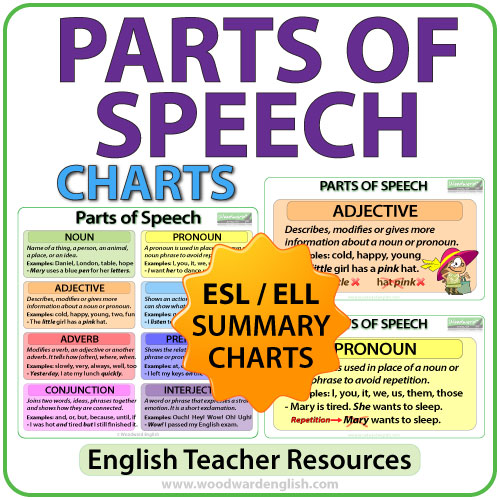
We have created the following summary charts that can be used in the classroom or for homeschooling:

English Parts of Speech Charts - Word Classes

Monday, June 11, 2018

Say y tell estilo directo y estilo indirecto.


Say and tell in direct speech and reported speech. - Say y tell en el estilo directo y el estilo indirecto.


Present
Past
Participle
say / says
said
said
tell / tells
told
told

Podemos traducir say y tell en español como "decir". Sin embargo, en inglés usamos estos verbos en distintas maneras. Existen unas reglas que indican el uso de uno sobre el otro en inglés, aunque en general usamos say para "decir algo" y tell para "decir algo a alguien."
Por ejemplo;
  • “I’m tired,” she said. - “Estoy cansada,” dijo.
  • She told me, “I’m tired” - Me dijo, “Estoy cansada”

Say

Usamos say en el estilo directo y el indirecto. Si usamos say con un objeto personal, necesitamos usar to.
Direct speech - Estilo directo
  • "I'm hungry," he said. - "Tengo hambre,"  dijo.
  • "I need your help," Peter said to Mary. - "Necesito tu ayuda," Peter dijo a Mary.
  • She said, "Do you like to dance?" - Ella dijo, "¿Te gusta bailar?"

Reported speech - Estilo indirecto
  • He said he was hungry. - Él dijo que tenía hambre.
  • Glen said to Mike that he needed his help. - Peter dijo a Mary que necesitaba su ayuda.
  • She asked me if I liked to dance. - Me preguntó si me gustaba bailar.

Tell

También podemos usar tell con el estilo directo o el indirecto, aunque el uso con el estilo directo no es tan común. Cuando usamos tell necesitamos usar un objeto indirecto que va detrás del verbo.

Direct speech - Estilo directo
  • He told me, "I'm hungry." - Me dijo, "Tengo hambre."
  • Peter told Mary, "I need your help." - Peter dijo a Mary, "Necesito tu ayuda."

Reported speech - Estilo indirecto
  • He told me that he was hungry. - Me dijo que tenía hambre.
  • Peter told Mary that he needed his help. - Peter dijo a Mary que necesitaba su ayuda.

Otros usos de tell:
Usamos tell cuando damos órdenes o instrucciones.
  • He told me to shut up. - Me dijo que me callara.
  • She told us to hurry. - Nos dijo que nos diéramos prisa.
  • They told us to come in. - Nos dijeron que entráramos.

Usamos tell para dar o pedir información.
  • Can you tell me your name please. - Díme tu nombre, por favor.
  • You told him the address of the office? - ¿Le dijiste la dirección de la oficina?

Usamos tell con cuentos o bromas. En estos casos, podemos traducir tell como "contar" en español.
  • He told us a funny story. - Nos contó un cuento divertido.
  • "Tell me a joke," she said. - "Cuéntame un chiste," dijo ella.

También usamos tell con;
  • "Tell me the truth," she said. - "Dime la verdad," dijo ella..
  • "Could you tell me the time, please?" she asked. - "Podrías decirme la hora, por favor?" me preguntó.

Friday, June 8, 2018

LinguaPracticaVR - Learn English in Virtual Reality


vr%2Bwaterfall%2B2.PNG
As I walked around the BETT Show last week there seemed to be a vendor selling a virtual reality product at every turn. LinguaPracticaVR is one of those VR products that I tested. 

LinguaPracticaVR offers free English lessons in a virtual reality context. LinguaPracticaVR builds short lessons into virtual reality images of places in Ireland and the United Kingdom. For example, in the screenshot below you will see an image of the Powerscourt Waterfall. Within that image there are three short lessons about the words used to describe what is seen in the image. 

Applications for Education 
LinguaPracticaVR is a still in the early phases of its development, but there is excellent potential for its use as an instructional tool. One thing to note is that it seems to be built with high school age or older ELL/ ESL learners. I say that because one of the tours includes a visit to a pub.

Thursday, June 7, 2018

Lingualia, cursos de idiomas que se adaptan a ti


Lingualia no es sólo una red social para aprender idiomas en la que conocer gente y practicar con nativos, sino que además es una nueva y revolucionaria forma de hacerlo.

Pero... ¿qué significa que en Lingualia todo se adapta a cada usuario?

Generalmente todos los cursos online, ya sean de idiomas o de otras materias, siguen una estructura lineal, donde el usuario tiene que ir pasando unidades y lecciones que requieren siempre de un tiempo fijo y predeterminado. Y donde el curso es exactamente igual para todos los estudiantes independientemente de sus necesidades, edad, formación previa o intereses.

Sin embargo, en Lingualia se apuesta por por un sistema adaptativo, donde el usuario no es el que se tiene que adaptar al curso, sino que el curso automáticamente se adapta a las necesidades de cada usuario.

Lingu1

¿Cómo lo consiguen? De formas muy diversas:

Analizando tu progreso:
Hay estudiantes que tienen más facilidad en el vocabulario que en ciertos aspectos de la gramática como los verbos. A otros estudiantes les cuesta más la expresión escrita o la comprensión.
El curso se centra en lo que realmente necesita cada estudiante de forma automática.

Adaptándose a tu objetivo:
No es lo mismo un estudiante que quiere aprender inglés para mejorar su carrera profesional, encontrar un mejor empleo o completar su CV, que un usuario que quiere aprender idiomas para viajar, conocer nuevos amigos, o porque le gusta la cultura en general.

Motivación:
Mantener la motivación del estudiante es uno de los retos más importantes de los cursos online. Una de las formas de conseguir esto es personalizando los contenidos según tus intereses, aumentando así tu motivación.

Considerando tu tiempo disponible:
No importa si dispones de 5 o de 45 minutos, Lingualia se adapta a cada horario y es completamente flexible. Al no ser un curso lineal, no exige un tiempo mínimo para finalizar cada lección y es capaz de concentrar sesiones de aprendizaje y adaptarse a cada usuario.

¿Qué te ofrece Lingualia?
Lingu es el profesor inteligente hecho a tu medida que utiliza inteligencia artificial para adaptarse a ti.
Con él progresarás más rápido porque se centra exclusivamente en tus necesidades. Te hará preguntas de forma progresiva, te guiará en aquello que necesitas reforzar y también te ayudará a repasar lo que ya has aprendido.

Lingu2

Juegos: reta a tus amigos a un duelo de idiomas a la vez que aprendes gramática, vocabulario o fonética de forma natural y divertida. Sólo tienes que responder correctamente y en el menor tiempo posible todas las preguntas del desafío.

Lecciones: material didáctico creado por profesionales de la educación y basado en el Marco Común Europeo de Referencia para las Lenguas (MCER) que trabaja todas las áreas lingüísticas a través de cuatro tipos de tarjetas educativas, también llamadas flashcards:
- Diálogos: mejora tu comprensión a través de diálogos reales donde se muestra el uso contextualizado del vocabulario y de las expresiones así como el de diversas estructuras gramaticales.
- Fonética: te enseñan la pronunciación más correcta y te ayudan a que mejores la tuya.
- Gramática: explicaciones fáciles de leer, claras y directas. Aprender gramática no tiene por qué ser duro.
- Vocabulario: aprende miles de palabras importantes con la ayuda de imágenes, su pronunciación y la definición.

Actividades: ejercicios que se inspiran en los gustos, en las preferencias y progreso de cada estudiante y que se comparten con los otros miembros de la comunidad de Lingualia.
Los usuarios pueden comentar, hacer correcciones y sugerencias, y también aportar su punto de vista o sus conocimientos a los ejercicios realizados por otros estudiantes.

Lingu3

¿Quieres probar las nuevas lecciones?

Regístrate ahora en Lingualia

Lingualia incluye más de 200 lecciones, divididas en 4 niveles (A1, A2, B1 y B2), compuestas por un diálogo, vocabulario, frases de ejemplo, fichas de gramática, fonética y una revisión final, donde Lingu - nuestro profesor inteligente – examinará tu progreso de forma detallada.