ENGLISH FOR EVERYONE

ENGLISH FOR EVERYONE

Friday, June 22, 2018

¿Qué son y cómo utilizar las "transitions"?


Un "transition" es como un puente en el lenguaje. Sirve para conectar ideas.

Foto: bethcoll.com

Pregunta:

¿Podrias por favor darme una explicacion clara, como las que siempre das...de qué es transitions?
En cuanto a las transitions, tengo estos ejemplos en mi libro: No theory of intelligence has yet been proved.Nonetheless, many institutions believe success depends on high IQ and EQ.
 He must have a high IQ. Otherwise, he wouldn't have gotten that job. Zoi

Respuesta:


Concepto de "transition"

Cuando hablas, o escribes, necesitas palabras o un grupo de palabras para conectar tus ideas. Estas palabras,  o grupo de palabras, se llaman en inglés "transitions".

"Transition" es más amplio que "conjunction" (conjunción) o "connector "(conector), ya que en las Transitions" no solo incluimos conectores, si no también cualquiera otra palabra, o frase, que sirva para unir ideas.

Aunque, con mucha más frecuencia, cuando hablamos de "transitions" nos referimos un tipo de palabras concretas como: Nonetheless, However, Although, etc.

Para que te resulte más fácil recordar qué es un "transition", piensa en que es como un "puente" que une nuestras ideas. Si no utilizas, estas palabras, o grupo de palabras, tus ideas quedarían desconectadas y quien te escucha no podría comprender bien lo que le estás diciendo.

En los ejemplos que nos da Zoi, tenemos las siguientes "transitions":
  • Nonetheless, many institutions believe success depends on high IQ and EQ. 
  •  Sin embargo, muchas instituciones creen que el éxito depende de un alto CI (Coeficiente Intelectual) y IE (Inteligencia Emocional).
  • He must have a high IQ. Otherwise, he wouldn't have gotten that job.
  • Él debe tener un alto CI, sino no habría conseguido ese trabajo.
Si te fijas "nonetheless" inicia la oración para unir el texto anterior (que en este caso desconocemos) con un nuevo. Y, lo mismo ocurre con "otherwise".


Fines de las transitions

Como veremos a continuación, las transitions pueden tener distintos fines.

Por ejemplo:
  • Enfatizar: Notably because she is the smartest student in this class.  Especialmente porque ella es la alumna más inteligente de la clase.
  • Comparar o contrastar:  She is not as tall as her sister. Ella no es tan alta como su hermana.
  • Mostrar relación causa y efecto: As a result, she burnt herself. Como consecuencia de ello, se quemó.

Por tanto, el truco está en saber utilizarlas correctamente según su finalidad y contexto. Para ello debemos practicar con frases. Más abajo, dejo ejercicios.

Lista de Transitions

 Aquí tienes una buena lista de palabras que se utilizan como transitions, en distintas situaciones.

Para los más avanzados, dejo aquí un vídeo en el cual se explica cómo utilizar las "transitions". Sirve como ejemplo para el IELTS y TOEFL. 

Thursday, June 21, 2018

Curso IELTS Académico patrocinado por Kaplan.


Hemos llegado al final del curso. Si has llegado hasta aquí, felícitate porque uno de los factores que más influye en el progreso con el inglés es la CONSTANCIA.


The Life of an astronaut
    Reading

    Leeremos un artículo de un blog del "The Economist" para incrementar nuestro vocabulario. Recuerda que una de las claves para conseguir un nivel alto de inglés es un amplio conocimiento de términos y estructuras y qué mejor manera que leyendo. Así que vamos a ello.

    Esta es la fuente.


    Becoming an astronaut

    Frequent travel may be required

      by K.M. | CAMBRIDGE

    BECOMING an astronaut sounds to most like something only small children and fighter pilots would seriously aspire to. Preparing to be one would be like getting ready to win the lottery or be hit by a meteorite. So, despite longing to float free among the stars ever since she can remember, your correspondent long ago took her fascination with the cosmos in a different direction and became anastrophysicist. Yet here she is, filling in the paperwork NASA requires from people it deems "highly qualified" applicants for the Astronaut Candidate Class of 2013.

    Last year, at an astronomy meeting, Babbage bumped into an astronaut she had last seen on NASA's live spacewalk webcast, climbing into the Hubble space telescope. Himself an astrophysicist, John Grunsfeld worked on the Hubble three times. After a mildly embarrassing display of fawning adulation, Babbage told him she would love to be an astronaut and asked if it was crazy to apply. He said it would be crazy not to. So when the call for applications appeared a few months later—publicised on geekywebsites and an equally science-heavy Facebook feed—the decision was a no-brainer.

    Rather than apply to the astronaut programme directly you in fact file an application for the astronaut-candidate programme, a two-year training course during which hopefuls are evaluated in a range of skills that might come in handy on an actual mission. The online form, which goes up every couple of years, is straightforward. First, a number of requirements must be met. You have to be an American citizen, 62 to 75 inches tall (157-190cm, a range apparently dictated by the dimensions of Russia's Soyuz spacecraft that ferries NASA astronauts to and from the International Space Station these days) with 20/20 vision (or suitable correction) and healthy blood pressure. You must also be able to swim three lengths of a pool wearing a flight suit and shoes. This makes sense—in training, low gravity (or, in the jargon, microgravity) environments are simulated under water in swimming pools; and a mission might end with the re-entry vehicle landing somewhere in the ocean.

    Sigue leyendo

    ********

    ¿Qué palabras son nuevas para ti?

    • longing to float free : anhelando flotar libre
    • astrophysicist: astrofísico
    • deem(s): v. parece
    • bumped into: v. encontrarse casualmente con alguien
    • webcast: retransmisión vía internet
    • midly embarrassing display of fawning adulation: ligeramente bochornosa demostración de servil adulación
    • geeky: friki
    • feed: en este caso, aviso de actualización de Facebook
    • no-brainer: pan comido, muy fácil
    • hopefuls: candidatos
    • that might come in handy: podría resultar práctico
    • straightforward: directo, sin complicaciones
    • jargon: jerga
    • re-entry vehicle: vehículo de regreso (a la tierra)

    Sigue buscando el significado de las palabras que no sabes en el resto del texto.  

    Nota:  Es la última unidad del curso No se te ocurrirá saltarte este importante ejercicio ¿no?


    Como hemos hecho en todas las unidades, una vez que acabes de buscar los significados, pon el texto, poquito a poquito en IVONA, con acento británico para escuchar cómo suena.

    Las palabras sueltas las puedes poner en Howjsay.

    A continuación:

    1. Escribe un resumen del texto.
    2. Dilo en voz alta.
    3. Traduce oraciones sueltas y las dices en español y en inglés, una y otra vez.

    Ahora haremos este ejercicio de Reading que nos trae Kaplan.

    Si quieres conseguir una puntuación alta en el Reading, sigue estos consejos.

    Listening

    Vamos ahora con unos consejos muy útiles sobre el Listening que nos da Norberto, profesor especializado en el IELTS de Kaplan, Dublin.

    Hola a todos,

    Me gustaría daros un consejo sobre como realizar la prueba de listening, en concreto, como predecir las respuestas para rellenar los huecos.  Como ya sabes la parte de listening del examen IELTS consiste en 4 partes, las primeras dos partes son temas generales, la tercera y cuarta parte son temas académicos.
      Parts 1 – General, conversacion, dos participantes.
      Part 2 – General, presentación – normalmente un solo participante.
      Part 3 – Académico, hasta tres o cuatro participantes (alumnos y profesores).
      Part 4 – Académico, lecture – normalmente un solo participante.
    Es muy importante que sigas los siguientes pasos:
    • Lee y sigue las instrucciones atentamente.
    • Lee todas las respuestas.
    • Subraya las palabras clave.
    • Dedícale tiempo a predecir las posibles respuestas.
    • Al rellenar los huecos, comprueba siempre que la frase tiene sentido lógico y gramatical.
    Ahora vamos a realizar un ejercicio, tendrás que elegir la palabra adecuada para cada hueco. Antes de completar el ejercicio, tómate algún tiempo y analiza cada hueco y su posibles respuestas. Fíjate en las palabras que preceden y en las que siguen a los espacios para decidir el tipo de palabra que falta  (nombre, verbo, adjectivo, etc.). Comprueba si las palabras están en singular o plural. Por último, ten en cuenta que las palabras deben tener sentido lógico en el contexto dado.
    Ejercicio 1.  Lee el ejercicio de debajo y rellena cada hueco con la palabra más apropiada de las palabras mostradas en negrita.
    Keeping Animals in Captivity   (Succeed in IELTS – Conversación y Vocabulario, GlobalELT)
    Usa cada palabra una sola vez.
    cures – extinct – companionshi – cosmetics – cruelty – cages
    humane – research – unstimulated – put down – conservation
    neglect – respect – haven – educate – appreciate – spirit - pleasure
    abandon – companions – tests – enclosures – endangered
    Keeping animals in captivity is a form of (a) _____________________ whatever way you look at it and there are countless
    examples of this.  Take the circus, where we make animals perform tricks for our (b) _____________________ and whip them when
    they do not. If that’s not bad enough, circus owners keep their animals in tiny (c) _____________________ and transport them
    all around the country in (d) _____________________ barely big enough for them to fit into. And what about the equestrian
    world?   The wild, natural (e) _____________________ of the horses is ‘broken’ out of it (that is even the verb horse-breakers
    use…) and it is ‘trained’ – again with a whip – to be obedient and forced to race or jump, and risk serious harm in the process.
    And what happens when a horse gets injured? The owners simply get it (f) _____________________ . We even use animals
    to carry out laboratory (g) _____________________ . We test new (h) _____________________ and new drugs on animals, and we
    force them to endure all kinds of pain in the process. The zoo is supposed to be a safe (i) _____________________ though,
    right?  Wrong. In many poor countries, zoo animals are mistreated and left (j) _____________________ and lonely for lack of
    (k) _____________________ . And as for pets, well, we simply objectify them and treat them like toys if they’re lucky. not, we
    (l)_____________________ them or (m) _____________________ them for the most part.
    A continuación, pondremos a prueba los consejos de Norberto con el siguiente ejercicio de listening.

    Si quieres obtener una puntuación alta en el listening, sigue estos consejos.

    Speaking

    Practicaremos las 3 partes del Speaking con este vídeo. 

    La primera vez deberás escuchar las respuestas que da el profesor Ryan que hace de candidato. La segunda vez, en cada pausa, deberás repetir las respuestas que da Ryan.

    Si quieres conseguir una puntuación alta en el Speaking sigue estos consejos.

    Writing

    Merece la pena mirar este vídeo sobre como afrontar el Task 2, que consiste en escribir un essay de 250 palabras aproximadamente. El vídeo es largo pero merece la pena.


    Aquí tienes un ejercicio para poner en práctica los consejos de Ryan.

    Si quieres conseguir una puntuación alta en el writing sigue estos consejos.


    Vocabulary 

    Aprenderemos vocabulario relacionado con el Universo y el Espacio.

    Aquí tienes una muy buena lista de palabras con sus significados y sonidos.

    Seguimos aprendiendo el vocabulario del espacio con este vídeo. Muchos de estas palabras son exactamente iguales que en español, por tanto, lo importante es que sepas PRONUNCIARLAS. Recuerda que si no sabes cómo decirlas, no te sirven de nada.

    Con este vídeo que incluye una canción de Elton John aprenderemos vocabulario sobre el espacio. Increíble, pero cierto. Fíjate bien en el texto que aparece debajo del texto de la canción. Busca el significado de las palabras que no sepas en español.

    Pronunciation

    Veremos este vídeo sobre palabras cuya pronunciación generalmente se confunde. La pronunciación del vídeo es americana/canadiense.


    Grammar

    Practicaremos con oraciones complejas. Este tipo de oraciones te ayudarán a hablar y a escribir de una manera más sofisticada, y por tanto, si eres capaz de reproducir correctamente estas estructuras, tus posibilidades de sacar una puntuación alta en el IELTS incrementarán.

    Aquí tienes teoría y ejercicios  de la BBC sobre oraciones complejas.

    Wednesday, June 20, 2018

    The Math and Science of Valentine's Day


    Valentine's Day is less than two weeks away. In middle schools and high schools everywhere there will be students who are excited about it, some who dread it, and others who are indifferent. I always fell into the indifferent category. Wherever your students stand on Valentine's Day, the following two videos make for interesting lessons about Valentine's Day.

    The following video from It's Okay To Be Smart (produced by PBS Digital Studios) explains why humans kiss, the history of symbols associated with kissing, and some cultural views of kissing. When I saw this video I immediately thought of my friends who teach middle school and high school health classes.


    The following fun video, also from It's Okay to Smart, attempts to use math to determine the odds of a 25 year old woman finding love in New York. (Remember, the video is just for fun).


    Tuesday, June 19, 2018

    Diálogo en inglés > Madre Orgullosa de sus 2 Hijos

    En este diálogo en inglés presentamos a una madre que recibe buenas noticias por parte de sus hijos, lo que la hace sentir muy orgullosa de ellos. Harry le cuenta a su madre que un agente de talentos quiere entrevistarlo. El agente llevará a Harry a Nueva York. Su hermana Lucy también tiene buenas noticias, ella ha sido nombrada como la presidenta del Club de Italiano.

    Harry brings home more good news
    Harry trae a casa más nuevas noticias

    HarryPenny and I are going to break into the music business. Last night after our concert, a talent agent asked us to meet with him in New York.
    Penny y yo vamos a entrar al negocio de la música. Ayer por la noche después de nuestro concierto, un agente de talento nos pidió reunirnos con él en Nueva York
    MaryCongratulations! We'll give you some spending money for your trip.
    ¡Felicidades! Vamos a darte algo de dinero para tu viaje.
    HarryNo need. The agent is footing the bill for everything. And when we get there, he's going towine and dine us.
    No es necesario. El agente está pagando todos los gastos. Y cuando lleguemos allí, él va a invitarnos a festejar.
    MaryHe must think you're the cream of the crop.
    Él debe creer que ustedes son los mejores.
    HarryHe thinks we sound like the Green Day.
    Él piensa que nos parecemos a Green Day
    LucyWho are they?
    ¿Quienes son?
    HarryYou're really out of it. They're a popular rock band.
    Realmente no estás actualizada. Son una banda de rock.
    LucyOur family is certainly on a winning streak. I was elected president of the Italian Club today.
    Nuestra familia en verdad está en una racha ganadora. Hoy fui elegida como presidenta del Club Italiano.
    HarryThe Italian Club? Big deal!
    ¿El Club Italiano? ¡Gran cosa!
    LucyYou don't get it, Harry. This is only the beginning. Today, president of the Italian Club. Tomorrow, ambassador to Italy.
    No lo entiendes, Harry. Es solo el principio. Hoy presidente del Club Italiano. Mañana, embajadora de Italia.
    HarryWell, Ambassador, you'll need to wrap up my chemistry homework before you leave for the Italy Embassy.
    Bien, embajadora, tendrás que terminar mi tarea de química antes que vayas a la embajada de Italia.
    MaryA rock star and a diplomat. I'm so proud of both of you!
    Una estrella de rock y una diplomática. ¡Estoy muy orgullosa de ambos!

    Expresiones.

    Break into. Entrar en una profesión.

    Spending money. Dinero para pequeños gastos.

    Foot the bill. Pagar.

    Wine and dine. Invitar a alguien una noche o comida cara.

    Cream of the crop. El mejor de un grupo.

    Out of it. No consientes de las últimas tendencias, hábitos, modas modernas.

    Winning streak. Una serie de triunfos, una racha ganadora.

    Big deal. ¿Y qué? eso no es realmente importante.

    Wrap up. Terminar.

    Monday, June 18, 2018

    Conversación en Inglés > 2 Mujeres Hablando de Negocios por Teléfono


    Conversación de teléfono entre 2 mujeres, donde una pretende comprar el negocio de la otra. Carol de National Cookie Company llama a Mary. Ella quiere comprar sus galletas. Mary está muy contenta pero espera que su esposo cierre el trato.

    Mary gets a surprise call.
    Mary tiene una inesperada llamada.


    MaryHello?
    ¿Hola?
    CarolGood afternoon. Are you Mary, of Mary's Scrumptious Cookies?
    Buenas tardes. ¿Es Mary, de 
    Deliciosas Galletas Mary?
    MaryYes I am.
    Si lo soy.
    CarolMy name is Carol Miller, and I'm calling from the National Cookie Company. We're nuts about your cookies, and we'd like to sell them all over the country.
    Mi nombre es Carol Miller y la llamo de parte de National Cookie Company. Estamos encantados con sus galletas, y nos gustaría venderlos en todo el país.
    MaryUnfortunately, we're running on a shoestring out of our kitchen. We can't make enough cookies for you.
    Desafortunadamente, Operamos con un bajo presupuesto en nuestra cocina. No podemos hacer suficientes galletas para ustedes.
    CarolMy company wants to buy the recipe and the brand name from you.
    My compañía quiere comprar su receta y la marca.
    MaryOh yeah? Why would you want to do that?
    ¿Ah, sí? ¿Por qué quisieran hacer eso?
    CarolWe have a successful track record of buying small companies and turning them into big ones.
    Tenemos una exitosa trayectoria comprando pequeñas empresas y convertirlas grandes empresas.
    MaryIn that case, I'm sure we can come to an agreement.
    En ese caso, estoy segura que podemos llegar a un acuerdo.
    CarolGreat. You just made my day!
    Excelente. ¡Me gusta escuchar eso!
    MaryYou'll need to work out the nuts and bolts of the agreement with my husband. He's the business manager.
    Necesitas hablar de los detalles del acuerdo con mi esposo. Él es el encargado del negocio.
    CarolMay I speak with him now?
    ¿Puedo hablar con él ahora?
    MaryHe's at a meeting. I'll have him get in touch with you when he returns.
    Está en una reunion. Haré que se ponga en contacto con usted cuando regrese.
    CarolGood. I look forward to speaking with him.
    Bien. Espero con ansias hablar con él.

    Expresiones.

    All over. A lo largo de, en todas partes.

    On a shoestring. Presupuesto muy bajo.

    Track record. Trayectoria.

    Make one's day. Dar una gran satisfacción a alguien.

    Work out. Encontrar una solución, resolver algo.

    Nuts and bolts. Detalles, componentes básicos de algo.

    In touch with. Poner en contacto con alguien.

    Look forward to. Esperar ansiosamente.

    Friday, June 15, 2018

    Diálogo en Inglés > Llamada Airada a Proveedor


    Laura llama a Albert para decirle que un cliente encontró un pelo en una de sus galletas. Albert quiere que Laura olvide el asunto, pero Laura piensa que es algo serio y amenaza en no volver a comprar otra galleta de Albert.


    Albert gets an angry call from Laura
    Albert recibe una llamada airada de Laura

    LauraAlbert, a lady came into the Lucky Market today ranting and raving.
    Albert, una mujer vino al Lucky Market esta mañana protestando.
    AlbertOh yeah? What happened?
    ¿Ah sí? ¿Qué pasó?
    LauraShe found a blue hair in her chocolate chip cookie!
    ¡Ella encontró un pelo azul en su galleta de chocolate!
    AlbertAha. I can see how she'd be taken aback.
    Aha. Puedo imaginar como estaría de sorprendida.
    LauraDoes anybody in your family have blue hair?
    ¿Alguien en tu familia tiene el pelo azul?
    AlbertAs a matter of fact, my son's girlfriend Penny has blue hair.
    En realidad, la novia de mi hijo Penny tiene el pelo azul.
    LauraAlbert, I can't sell your cookies anymore.
    Albert, No puedo vender tus galletas más.
    AlbertAren't you blowing things out of proportion?
    ¿No estas exagerando las cosas?
    LauraThe health department would throw the book at me if they found out about this.
    El departamento de salud me sancionaría si se entera sobre esto.
    AlbertCouldn't we just sweep this under the rug?
    ¿No podríamos solo ocultarlo?
    LauraNo. This is too serious.
    No. Esto es muy serio.
    AlbertBut I was just getting a handle on the cookies business. Now what will I do? I don't have any other way of making a living!
    Pero estaba empezando a entender el negocio de las galletas. ¿Y Ahora qué voy a hacer? ¡No tengo otra forma de ganarme la vida!
    LauraMy heart goes out to you, Albert, but you need to get your act together. I want to sell chocolate chip cookies, not hair cookies!
    Lo siento mucho por ti, Albert, pero necesitas organizarte. Quiero vender galletas de chocolate, ¡no galletas de pelo!
    AlbertI guess I just knocked myself out for the past week for nothing.
    Supongo que trabajé duro la semana pasada por nada.
    LauraClearly!
    ¡Sin duda!

    Expresiones.

    Rant and rave. Hablar fuertemente, en un tono de enojo.

    Taken aback. Sorprendido (Casi siempre en un sentido negativo).

    As a matter of fact. De hecho, en realidad.

    Blow things out of proportion. Exagerar.

    Throw the book at (someone). Castigar o reprender severamente.

    Find out. Descubrir, enterarse.

    Sweep (something) under the rug. Ocultar algo, que puede llegar a ser un escandalo.

    Get a handle on. Comprender, entender.

    Ones heart goes out to (someone). Sentir pena por alguien.

    Get one's act together. Organizarse, para comenzar a operar de manera más eficaz.

    Know oneself out. Trabajar muy duro en algo.

    Thursday, June 14, 2018

    Ejercicio Reading IELTS - Herd Mentality


    Kaplan ha preparado para nuestro curso IELTS este ejercicio de Reading del IELTS.

    Verás que los párrafos del texto aparecen númerados con letra (igual que lo estarán en el examen). En este caso, deberás hacer dos tipos de ejercicios.

    El primero es identificar los temas (resumidos en un título) sobre los que se habla en el artículo. Como verás, cabe la posibilidad de que te pongan un tema sobre el que NO se habla en el artículo para nada. Así que ¡cuidado! el ejercicio tiene trampa.

    En segundo ejercicio deberás decir si el enunciado es verdadero, falso, o no aparece en el texto.

    Recuerda que al leer debes buscar "palabras o expresiones claves" que te den el sentido del texto. 

    Las respuestas a los ejercicios las encontrarás más abajo.


    -->
    READING PASSAGE 1 - HERD MENTALITY 

    A. Whenever a large group of people gathers together, there is always a danger that something will go wrong. The worst tragedy which can take place is a crowd surge resulting in a crush. In extreme cases, this can cause death by compressive asphyxia which is where pressure on the chest leaves the person unable to breathe properly.

    B. It is often assumed that it is panic which spreads through a crowd which results in an uncontrollable mass only thinking about their own safety. Recent research actually shows people are more likely to act altruistically in times of danger, helping others who are in peril. Their claim is that it is more to do with the management, design and information systems failing than any actions by the participants.

    C. With the increasing power of computers, scientists are able to predict how a group will react in a given situation. Crowd Dynamics is a model which is based on three controllable factors which combine mathematics and psychology. The first stage looks at the design of the crowd’s environment, taking into account the way that they will move through a venue as well as any potential bottlenecks. Secondly, the information supplied to the crowd before, during and after the event is evaluated. Finally, how the crowd is managed is studied.

    D. A good example of this principle in use is the new Olympic stadium which is being built in East London, England. This enormous arena will be able to hold 80 000 people comfortably in two tiers. Naturally, with this many people together at any one time, it is important to ensure that their movements can be predicted in order to keep them safe.

    E. The stadium is built on an island and to facilitate ease of access, five different bridges are being built. These lead the crowds to designated zones which are colour coded. Spectators will be able to see from the colour of their ticket which bridge they need to gain access to their seats. This system automatically means that the crowd can be divided up into much smaller sections of 16 000 and reduce jams.

    F. Although at first sight it may seem like a retrograde step, electronic signs are being removed. The thinking behind this is that electrical glitches will not affect the details being given to the spectators. By having more human stewards to help guide the crowds, information can be directed to where it is needed.

    G. The final change is to security. There will still be strict checks taking place, but they will be located further away from the venue where the park is wider thus accommodating more people. This will be followed by a more cursory check at the arena itself in the hope that this will keep the flow of spectators moving into the stadium rather than queues developing.

    H. Although the programs are not 100% accurate yet, it is hoped that by employing this kind of technology in the development of new venues, it will reduce the risk of serious accidents happening.

    ******
     ¿Sabes que puedes preparar el IELTS con Kaplan?

     *******
    Question 1 

    Reading passage 1 has eight paragraphs A – H. Use X if the heading is not used.

    Choose the correct heading for each paragraph from the list below. 


    I. The problems of overcrowding

    II. Controlling crowd numbers

    III. The assumption of human nature

    IV. Changes to security checks

    V. How Crowd Dynamics works

    VI. What is studied in Crowd Dynamics

    VII. Avoiding queues

    VIII. The dangers of large crowds

    IX. A modern example of Crowd Dyamics

    X. Reducing future risks

    XI. A way of reducing crowd numbers

    XII. True human nature

    XIII. A backward step

    XIV. Simplifying technology

    **********

    Questions 9 – 14 

    Are the following statements TRUE, FALSE or NOT GIVEN? 

    9. The London Olympic Stadium was designed to be built on an island.

    10. Removing electronic signs is a conservative step.

    11. Crowd Dynamics is based on manageable facts.

    12. People usually help others who are in danger.

    13. Security checks will be removed from the London stadium.

    14. New venues will use computers when being designed.

    *****
    Answers:
    Question 1
    I. X
    II. E
    III. X
    IV.G
    V. X
    VI. C
    VII. X
    VIII. A
    IX. D
    X. H
    XI. X
    XII. B
    XII. X
    XIV. F
    ****
    Question 2
    9. NOT GIVEN
    10. FALSE
    11. TRUE
    12. TRUE
    13. FALSE
    14. NOT GIVEN

    Wednesday, June 13, 2018

    Expresiones en inglés relacionadas con la música


    Una buena forma de aprender vocabulario es relacionándolo con imágenes.

    Kaplan, ha preparado unas ilustraciones para enseñanos expresiones en inglés relacionadas con la música. Verás que fácil es aprenderlas si memorizas la frase en inglés con su traducción al español y miras el dibujo.

    Te recomiendo que pongas las expresiones en IVONA (o software similar) para saber cómo suenan, de lo contrario no te servirán de nada saberlas.

    -->

    Expresión en inglésSignificadoEjemplo
    Elevator musicMúsica agradable pero aburrida que se toca en lugares públicos
    -I always listen to elevator musicat the dentist’s
    -Siempre escucho música aburrida en el dentista
    Ring a bellSonar algo a alguien
    -That rings a bell.
    -Eso me suena.
    For a songComprar, o vender, algo a un precio muy barato
    -I bought these shoes for a song.
    -Compré estos zapatos por cuatro perras.
    Like a broken recordAlguien que repite el mismo discurso una y otra vez
    -When she talks about her sister,she sounds like a broken record.

    -Cuando ella habla de su hermana parece un disco rayado.
    Blow your own trumpetFardar de tus propios éxitos o talentos
    -Peter often blows his own trumpet.
    -Frecuentemente, Peter farda de sus éxitos.
    Jam sessionTocar música de manera improvisada en un entorno informal
    -My friends had a jam sesión last weekend and the neighbours complained.

    -Mis amigos se pusieron a tocar música de manera improvisada el fin de semana pasada y los vecinos. protestaron.

    Aquí tienes la imagen preparada por Kaplan:


    Lee aquí el post original de Kaplan.

    Tuesday, June 12, 2018

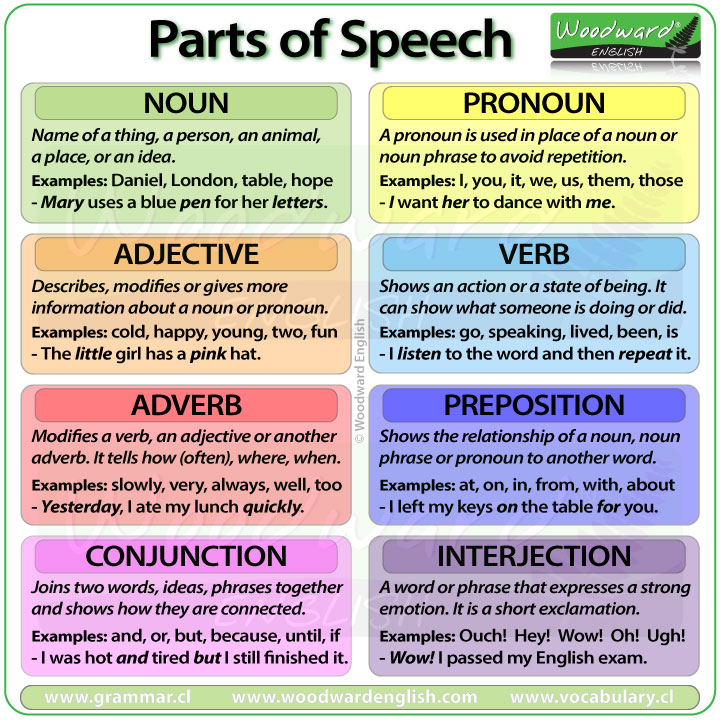
    Parts of Speech – Word Classes


    What is an adverb? What is a preposition? What is a…?
    These are questions that students sometimes ask when a teacher is explaining a grammar point.
    The different parts of speech (or all of those “grammar words” as some students call them) are important to know when learning English, or any other language.
    In order to help solve doubts about what the different parts of speech are and what functions they have, I created a summary chart and a video explaining the main differences between each one.

    Parts of Speech in English – ESL Video

    In our ESL video, we look at the eight parts of speech in traditional English grammar.
    These parts of speech, sometimes called word classes, include:
    Nouns, Pronouns, Adjectives, Verbs, Adverbs, Prepositions, Conjunctions, and Interjections.
    We give an explanation of how each word class is used and have included example sentences. For some of the parts of speech we also look at sub-classes such as subject pronouns and possessive pronouns, the different types of adverbs such as adverbs of manner, adverbs of frequency, etc.
    In the final section we talk about how some teachers sometimes include a 9th part of speech which can be either Articles or Determiners. Again, we include examples.
    This ESL video to ideal to give students a general overview of the different parts of speech in English.

    Summary Chart


    Parts of Speech in English - Nouns, Pronouns, Adjectives, Verbs, Adverbs, Prepositions, Conjunctions, and Interjections.

    English Teacher Resource

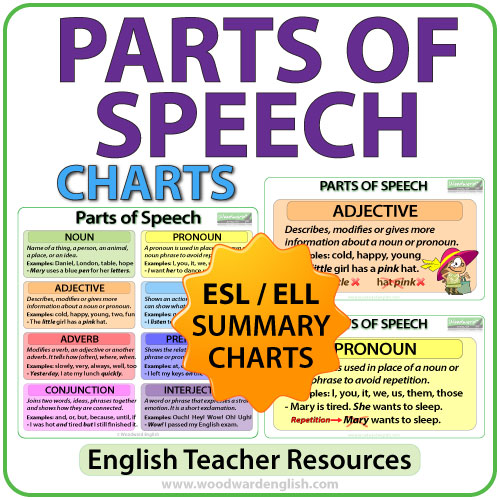
    We have created the following summary charts that can be used in the classroom or for homeschooling:

    English Parts of Speech Charts - Word Classes